Save a round trip
With HTTP/3 and Happy Eyeballs v3
performance.now() 2026 · Amsterdam · 20 November 2026 · Max Inden · MozillaMax Inden
- I work on the Firefox networking stack at Mozilla.
- HTTP/3 and QUIC (neqo).
- Happy Eyeballs v3 in Firefox (mozilla/happy-eyeballs).
- Fast UDP I/O for Firefox in Rust.
- Before: libp2p, Prometheus, Kubernetes.
1 · Protocols evolve
1991: plain HTTP over TCP
1 · Protocols evolve
1999: add security with TLS
1 · Protocols evolve
2018: TLS 1.3
1 · Protocols evolve
2021: QUIC, transport and TLS in one handshake
A new transport protocol: QUIC runs over UDP, not TCP.
1 · Protocols evolve
2021: QUIC 0-RTT, the request goes in the first packet
1 · Protocols evolve
What one round trip costs
1 · Protocols evolve
QUIC connects in about half the time
1 · Protocols evolve
Example: one page, then three more servers
index.html from one server, then a style sheet, a font and a script from three other servers, in parallel.
HTTP/2
HTTP/3
repeat visit
index.html has arrived.2 · Rolling out new protocols
Why HTTP/3 does not always work
| Antivirus | Inspects HTTP/3 and breaks it, at home and at work. | bug 2034178 bug 1919678 |
| VPN | Smaller packets and virtual network interfaces stall HTTP/3. VPN DNS resolvers often do not return HTTPS records. | bug 1734110 bug 1989895 |
| Network | Some networks block UDP. Rare today: QUIC works 97%+ of the time across Meta's apps and sites. | RFC 9308 Meta |
2 · Rolling out new protocols
IPv6: standardised in 1998
IPv4 192.0.2.1 · IPv6 2001:db8:85a3::8a2e:370:7334
2 · Rolling out new protocols
TLS 1.3: standardised in 2018
2 · Rolling out new protocols
What makes a transition work
“Transition is easiest when changing only one entity still benefits that entity.”
RFC 8170, “Planning for Protocol Adoption and Subsequent Transitions”, Internet Architecture Board, 2017
2 · Rolling out new protocols
HTTP/3
3 · Clients race
Happy Eyeballs: race the options
A, AAAA or HTTPS record · IPv4 or IPv6 · TCP + TLS or QUIC · HTTP/1.1, 2 or 3 · with or without ECH
3 · Clients race
Happy Eyeballs: race the options
3 · Clients race
Why “Happy Eyeballs”?
Network operators call users eyeballs.
They are latency sensitive, often on lossy, bad networks.
Optimizing for latency makes eyeballs happy.
3 · Clients race
With Happy Eyeballs: more page loads over HTTP/3
3 · Clients race
First contentful paint (FCP) is faster at every percentile
3 · Clients race
Largest contentful paint (LCP) is faster for most page loads
4 · Servers advertise
Two ways to advertise HTTP/3
| 1st connection | 2nd | 3rd | … | |
|---|---|---|---|---|
1. Alt-Svc HTTP headerin the HTTP response
Alt-Svc: h3=":443"; ma=86400 |
HTTP/2 | HTTP/3 | HTTP/3 | HTTP/3 |
2. HTTPS DNS record in DNS, before connecting
example.com. 3600 IN HTTPS 1 . alpn="h3,h2" |
HTTP/3 | HTTP/3 | HTTP/3 | HTTP/3 |
4 · Servers advertise
Enable and advertise
- Enable HTTP/3, next to HTTP/2 and HTTP/1.1.
- Send an
Alt-Svcheader. - Publish an HTTPS record with
alpn="h3". - Enable QUIC 0-RTT.
4 · Servers advertise
Most servers and CDNs already support it
| Server, proxy | HTTP/3 | 0-RTT |
|---|---|---|
| Caddy | yes | yes |
| LiteSpeed | yes | ? |
| Envoy | yes | yes |
| HAProxy | yes | yes |
| H2O | yes | ? |
| Traefik | yes | yes |
| IIS | yes | ? |
| nginx | yes | yes |
| Apache httpd | no | no |
| CDN | HTTP/3 | 0-RTT | HTTPS record |
|---|---|---|---|
| Cloudflare | yes | yes | yes |
| Akamai | yes | yes | yes |
| CloudFront | yes | ? | yes |
| Google Cloud | yes | yes | ? |
| Fastly | yes | yes | no |
| Azure Front Door | no | no | no |
| Vercel | no | no | no |
5 · Check your site
Check your site
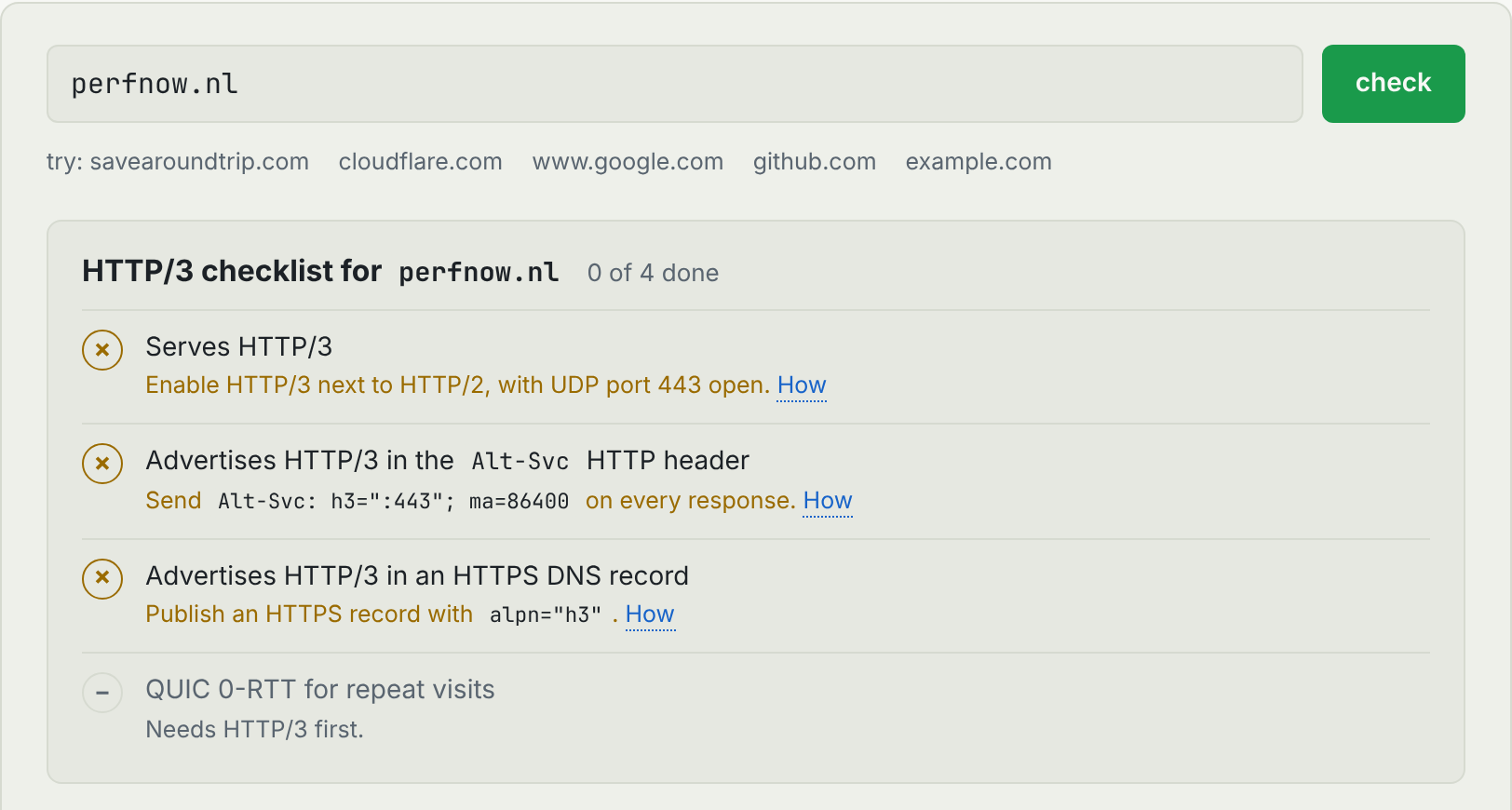
A live tester for your website.
How we can save the world a round trip
- Serve HTTP/3 and send an
Alt-Svcheader. - Publish an HTTPS record with
alpn="h3". - Offer QUIC 0-RTT.
- Check your site on savearoundtrip.com.
Servers advertise, clients race.
Max Inden · max-inden.de · @mxinden@mastodon.social · mail@max-inden.de